~ 4 min read
GRAIL EOSC Gravity Update Month 3 and 4
GRAIL EOSC Gravity Project Month 3 and 4 Update
The Grant Reuse and Abandoned Ideas Library is an EOSC Gravity funded Preparatory Project exploring what it would look like to participate in the Federations’ Tripartite Node Enrolment. In our first blogpost, we detailed our orientation process and reflected on the obstacles we had experienced in getting used to working within the EOSC framework. In this post, we will focus on the work we have been doing behind the scenes to put together our recently submitted Project Charter, a document whose function is to describe what GRAIL would be if it were enrolled as a Node, a function it took us quite a while to fully understand.
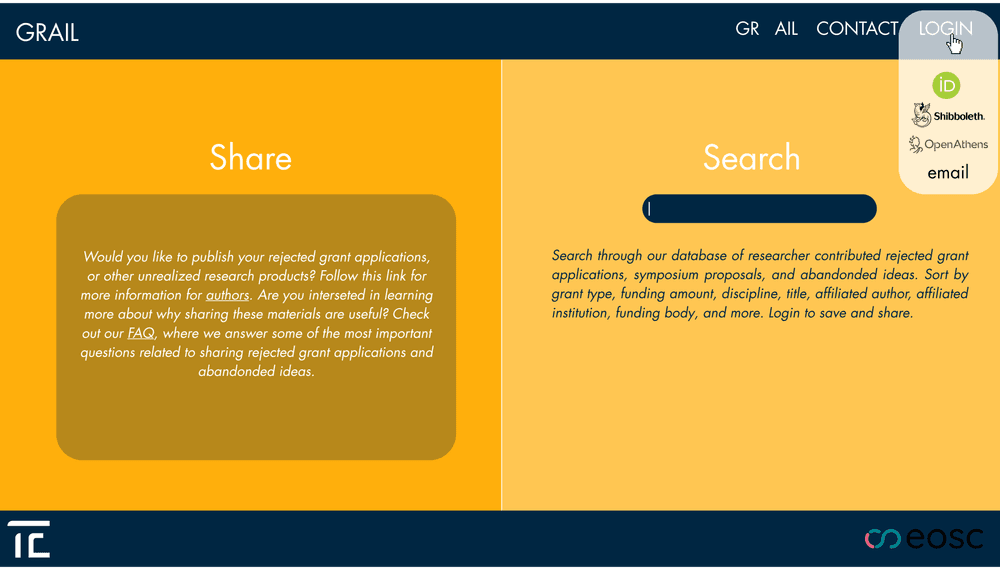
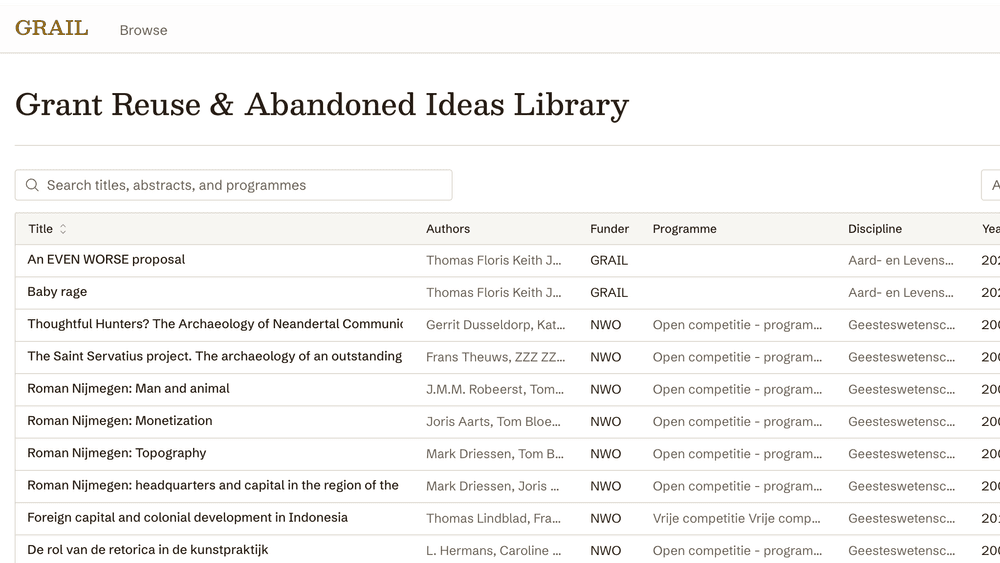
For most of month 3, we were focused on doing the actual work we promised we would deliver in our project plan – finalizing and analyzing the qualitative interviews we conducted, building out spec pages and digital architecture for the repository itself, working on the legal framework for the functioning of a repository for rejected grant proposals and abandoned ideas, determining the governance and organizational structure of GRAIL, and establishing the network in which we would be embedded as a digital service provider. Our technical team was able to get a demo of the repository live, and we were feeling quite happy with our progress.
In month 4, we began translating this work into the project charter, each working group taking responsibility for a section that corresponded to their area of expertise. We consulted publicly available examples of past Project Charters for inspiration and insights and had filled out most of the document by the time the EOSC Academy session on Project Charters occurred, a few days ahead of the due date. It was there that we learned that the Charter should not present any of our preparatory grant work – the interviews, the legal review, the metadata scoping, not even the demo. Instead, we were to fill out the Project Charter as if we were applying to the Tripartite Node Enrolment without including any of the project milestones described in the project plan of the Preparatory Project. To be fair, there were two footnotes on sections related to specific timelines and milestones that we should make a new timeline unrelated to the Preparatory Grant. However, it was not clear to us that this meant the entire Project Charter should be executed as a disjoint deliverable.
The EOSC Academy session was, therefore, immensely useful for us as a project team. It does make me think that perhaps the offering dates could be more strategically aligned with project deliverables, as this academy session was only a few days ahead of the final due date. However, our experience nonetheless highlights the value of the Academy for participants of the EOSC Federation funding schemas.
Ultimately, the reframing did help us clarify some of the details related to GRAIL. The Charter’s technology-readiness (TRL) self-assessment, for instance helped us evaluate how deployable the elements of our demo were. Currently, our demo runs a working OIDC/PKCE authentication flow against ORCID, registers test DOI4s under our Crossref prefix and carries a submission through a full metadata pipeline end to end. There were also aspects that we recognize are far from the required technology readiness level 7. The Project Charter covers resource-catalogue registration, helpdesk federation, service monitoring, and a FitSM-aligned Service Management System that we just simply cannot develop with the resources currently available to us. This raised a question for us as a team – should we envision the future of GRAIL as dependent upon continued funding from EOSC, or should we develop the infrastructure as possible to host independently?
Relatedly, we spent some time thinking about how GRAIL could best fit into the existing EOSC Node landscape. There already exists a Node in the Netherlands – the SURF node. We also are aware that there are private discussions with other major service providers in the Netherlands to develop either additional Nodes or one large national Node under which more specific Nodes are deployed. As I mentioned in previous posts, GRAIL is unique within the Gravity Preparatory Proposal system as we are neither a pre-existing infrastructure nor a national thematic Node. Maybe it would be best for us to be a part of a larger, national network of Nodes?
In the coming months, we will think about these questions within the GRAIL team while we finalize the last deliverables for this grant, our proposed contribution to the EOSC Academy Matrix and our final presentation of our efforts undertaken in this period. After our very positive experience with the Academy in this period, we are looking forward to developing our contribution. Until then…
Maura Cassidy Burke on behalf of the GRAIL team

Maura Burke is finalizing her PhD on the philosophy of science at Utrecht University. Her work focuses on the nature of human cognition and its role in the nature of scientific knowledge.
License
GRAIL EOSC Gravity Update Month 3 and 4 by Maura Burke is licensed under a Creative Commons Attribution 4.0 International License.