~ 7 min read
GRAIL EOSC Gravity Project Month 1 and 2 Update
ByMaura BurkeOrcID
GRAIL – the Grant Reuse and Abandoned Ideas Library – is an EOSC Gravity funded Preparatory Project. We imagine GRAIL as a repository for research products that otherwise never get shared or credited. The preparation of grant applications requires substantial fiscal and human resources, yet the vast majority never result in funding. A rejection does not necessarily signal poor quality. Given the volume of applications submitted by researchers of comparable quality, funding bodies inevitably reject proposals that are scientifically sound. This challenge is only likely to increase as generative AI tools lower the barrier to drafting competitive grant proposals.
At the Center of Trial and Error, we have long been guided by a commitment to sharing scientific products on the basis of their intrinsic merit, rather than whether they conform to prevailing evaluative metrics or academic conventions. We do so because we see that existing incentive structures within academia can encourage questionable research practices and reduce the transparency, efficiency, and reliability of scientific research. GRAIL emerged from conversations within the Center dating back to 2019 and reflects our desire to address some of these misaligned incentives by making overlooked scholarly work visible and reusable.
Going into this preparatory phase, we assumed that the central idea behind GRAIL was relatively straightforward. People submit materials, we make them findable, searchable, and citable – et voilà, a repository. Our IT team has very kindly walked us through why that is not, in fact, the case.
Developing GRAIL as a potential EOSC Node has required us to think far beyond the repository itself. The ethos of the EOSC Federation is to make open science services interoperable, sustainable, and accessible across Europe. That means governance, metadata, security, authentication, and long-term sustainability are fundamental design questions for us.
One realization during M1 and M2 has been that GRAIL occupies a somewhat unusual position within the EOSC ecosystem. We are not an existing service seeking federation, we are not a research community or competence center. We are designing an entirely new infrastructure project. As a consequence, we have occasionally found it challenging to determine how existing EOSC guidance applies to our project.
Our IT team, for example, is still determining whether GRAIL should be developed to meet the requirements of a Federated EOSC Node, or what the practical implications of the SSO requirements will be. Our project manager continues to explore how the sustainability of GRAIL is related to its status as an EOSC Node, and to what extent GRAIL should make design decisions that require access to greater fiscal funding. Meanwhile, our qualitative researcher has been considering how to frame the community insights garnered from participant interviews with the objectives and deliverables of the EOSC Gravity program.
However, I would like to give credit to EOSC in how they are engaging with these sorts of challenges. EOSC is a growing initiative, and throughout our interactions is has become clear that the Federation’s governance documents and overall visions are still evolving. Rather than presenting these documents as fixed, EOSC has been inviting the community to contribute to their development and operations. I was pleased to participate in the 15 June workshop on applying the EOSC Federation Handbook, in which organizers and participants worked together to better understand both the content of the Handbook and its practical implications for developing future EOSC Nodes.
Several discussions struck me as particularly relevant to GRAIL. For example, should EOSC Nodes primarily be organized geographically or thematically? At present there is no EOSC Node-NL, although there is the Netherlands-based EOSC Node SURF. Should the Federation eventually pursue a model in which each Member State hosts a single national Node supporting multiple services? Or, should thematic Nodes exist alongside geographically organized ones, allowing infrastructures like SURF and a future GRAIL Node to coexist?
A related question concerns coordination between Nodes. Currently, GRAIL is independently establishing relationships with existing infrastructure providers, including SURF. Could there be a larger role for the EOSC Federation itself in facilitating these connections, identifying existing expertise, and helping emerging Nodes navigate the broader EOSC ecosystem? As this blog series continues, we hope to share more reflections that may contribute to these ongoing conversations within EOSC.
Perhaps the most unexpected experience during these first months has been encountering what might be called the paradox of plenty. Historically, when developing new initiatives at the Center of Trial and Error, the limits of scope have largely been imposed by available time, funding, and personnel. We have rarely had to ask what should or should not be included because those decisions were largely made for us by practical constraints. The EOSC Gravity funding has created a rather different situation in which we have the opportunity to think intentionally about what GRAIL should become before committing ourselves to a particular implementation.
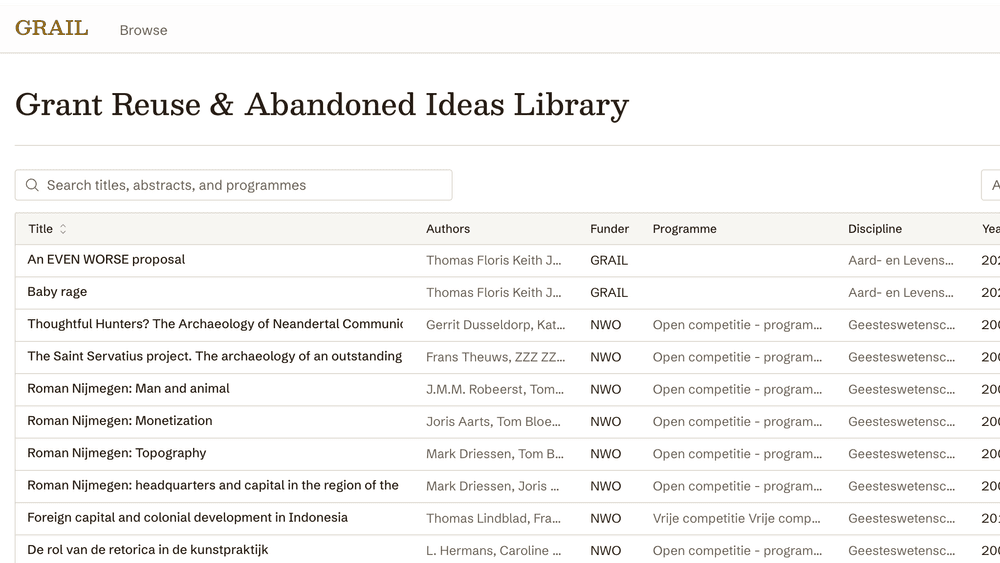
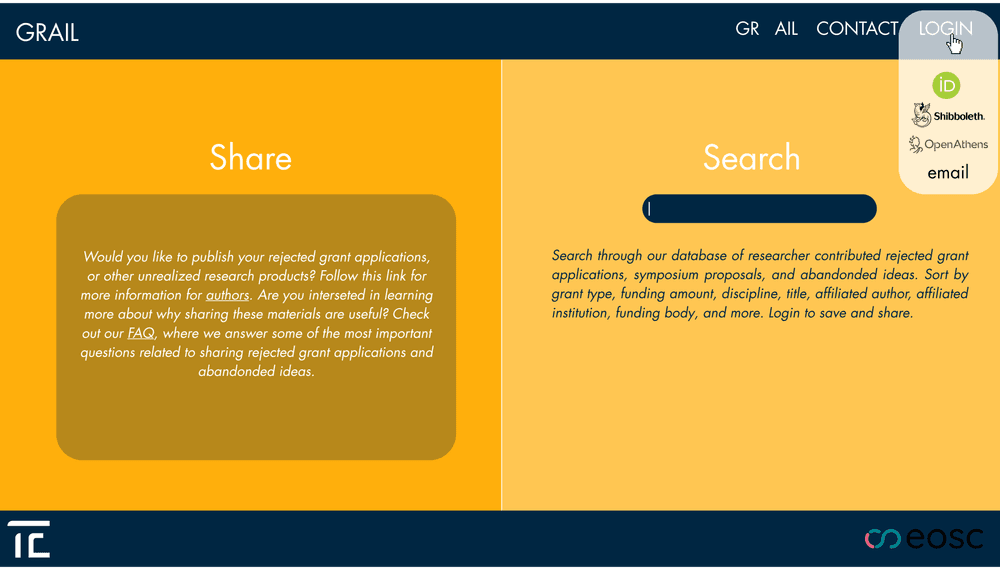
One of the key outcomes of our most recent internal GRAIL Charter Workshop was therefore the realization that we need greater clarity regarding the scope of the repository itself. To develop the technical architecture for GRAIL, we still need to provide our IT team with more concrete answers about how users will engage with GRAIL as a repository – how will they log in, will they be able to save entries, what sort of documents will be uploaded, how will they navigate the repository? The answers to these questions directly bear on what steps are next for our IT team, and scoping will therefore be a priority for us in the upcoming weeks.
In answering these questions, we will be drawing on the very valuable insights our qualitative research team has been collecting. We have been conducting interviews to better understand how GRAIL could become a genuinely useful research tool. One early finding recently shared with the team concerns the importance of changing the culture surrounding these kinds of research products. If we hope researchers will share rejected grant applications or other unrealized research materials, then greater recognition of their scholarly value will also be necessary.
The interviews suggest that researchers are enthusiastic about the prospect of sharing and discovering rejected grant applications, but the idea of abandoned ideas has prompted more questions. That response is understandable – unlike grant applications, abandoned ideas are not a clearly established scholarly object. When we use the term, we are thinking of materials such as unpublished position papers, unrealized symposium proposals, or research plans that never progressed further. These documents may nevertheless contain valuable ideas that could inspire future work, and they may also provide useful starting points for students, early-career researchers, or collaborators seeking new directions. Making these materials discoverable could contribute to more decentralized forms of collaboration and mentorship that extend beyond institutional or geographical boundaries.
At the same time, these conversations and the conversations with our IT team have prompted us to reconsider whether abandoned ideas should be included in GRAIL’s first iteration. We may instead choose to begin with a narrower focus on rejected grant applications, allowing our IT team to develop simpler and more robust metadata structures and technical workflows before expanding to additional research products. We are still firmly in the scoping phase of the project, and conversations with researchers, infrastructure providers, legal experts, and colleagues within EOSC remain essential to answering many of these questions.
Alongside these discussions, we have made encouraging progress with our legal consultant and with representatives from existing research infrastructures – and of course we are happy that our first deliverable has been approved by EOSC! Ensuring that GRAIL can integrate smoothly into the wider open science ecosystem remains one of our central priorities, and in the coming months we will continue to refine our governance, technical architecture, and understanding of researcher needs while working towards creating an infrastructure that is genuinely useful to the communities it hopes to serve.
On Behalf of the GRAIL Team,
Maura Burke

License
GRAIL EOSC Gravity Project Month 1 and 2 Update by Maura Burke is licensed under a Creative Commons Attribution 4.0 International License.